 Spring Tree Service
 Home / Services / Dead and Dying Trees
Dead and Dying Tree Assessment in Spring, TX
A tree that has changed is asking a question: stay or go. The answer depends on what is wrong, how fast it is getting worse, and what it would hit.
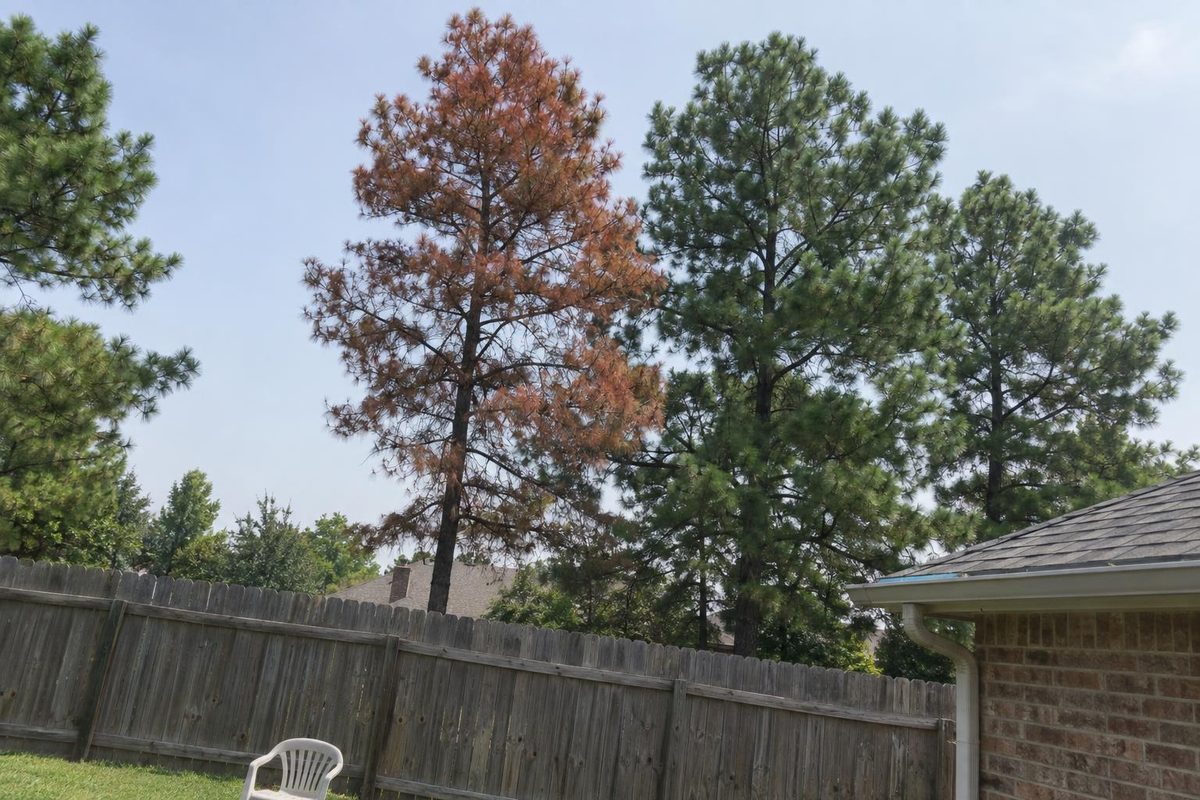
| What the crew finds | Usually means | Tier |
|---|---|---|
| Brown crown on a pine, beetle signs | Removal, and a look at nearby pines | Soon |
| Split at a fork on an oak | Removal or structural pruning, depending on size | Soon |
| Some dead limbs, rest healthy | Deadwood pruning | Routine |
| A new lean with heaved soil | Removal before the next wet storm | Soon |
| Leaves thin but no structural sign | Watch it; recheck next season | Routine |
If the person assessing the tree says they are ISA certified, that credential is voluntary and renewed every three years, and the International Society of Arboriculture lists credential holders publicly. After Beryl, a Texas A&M Forest Service forester advised Houston-area homeowners to hire a certified arborist to assess tree health.
Sources: ISA Certified Arborist Program Guide (August 2025); Community Impact, July 12, 2024.
Can a dying tree be saved?
Sometimes, if the cause is caught early and it is not structural. A crew can tell you whether it is a pruning question, a pest question or a removal question.
Who sprays or injects a tree?
In Texas, applying pesticide to trees for hire requires a license from the Texas Department of Agriculture. Ask to see it.
Is a dead tree a problem if it is far from the house?
Less of one. Distance matters: a dead tree that could reach a house, a fence, a play area or the street is the one to deal with first.
Tree Looking Different Lately?
Describe what changed and when. The company that calls back will say whether it is a now, soon or routine job.
Call (346) 220-2055 Send the Details