Spring Tree Service Pros logoSpring Tree Service Pros (346) 220-2055

Home / Pine and Oak Guide

Canopy guide

Pines and Oaks in Spring: What Changes Before One Fails

Most trees give notice. The notice is easier to read from the ground than people expect, and nothing on this page asks you to climb, cut or go near a line to read it.
Why the canopy here is mostly two kinds of tree

Walk any older Spring street and the tall trees are pines and oaks, with sweetgum and Chinese tallow filling gaps. Northampton’s own history describes the subdivision as hidden from the roads “by towering pine and oak trees mixed with sweet gum and Chinese tallow trees.” Real-estate guides to Cypresswood list live oaks and pines first, then crepe myrtles and magnolias.

The two main trees fail differently. A pine tends to go from the top: the crown changes color, then the whole tree dies standing. An oak tends to drop parts of itself: a limb, a split at a fork, a lean after the root plate shifts in wet clay.

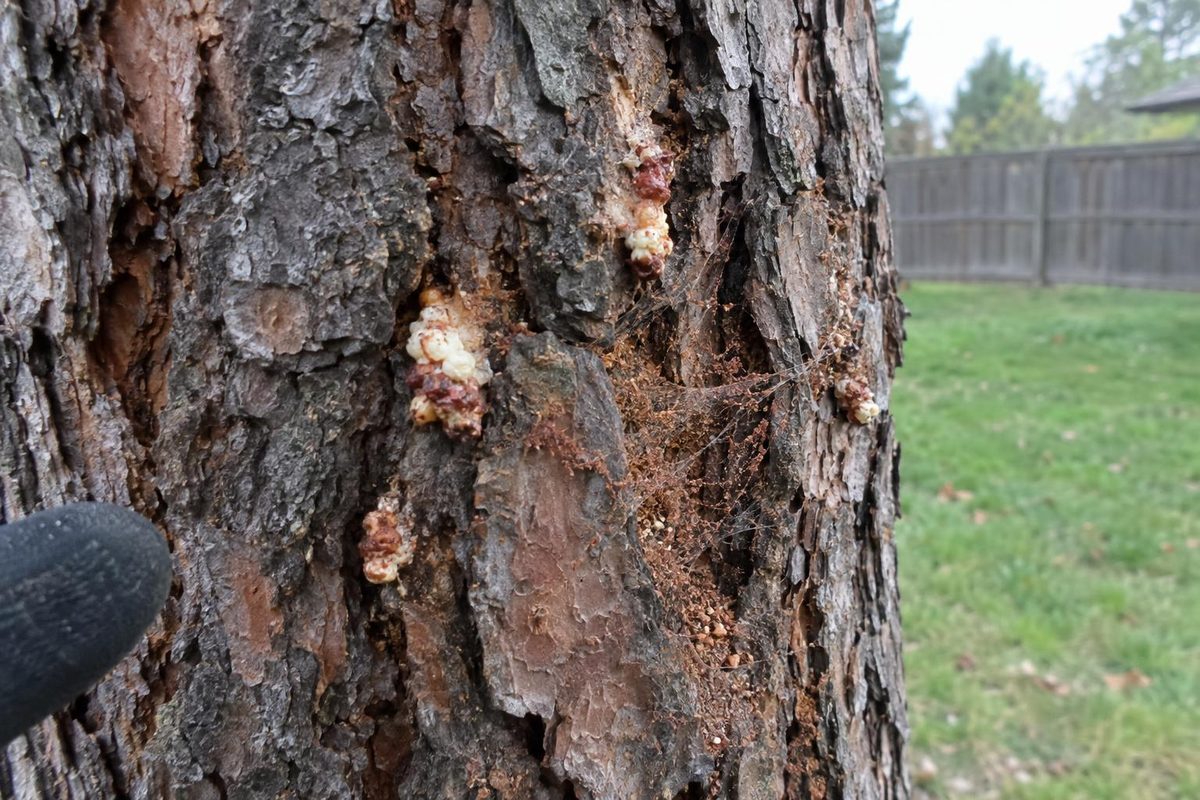
Close view of pine bark with small popcorn-like lumps of resin and reddish boring dust in the crevices
Pines

Signs in a Pine

The Texas A&M Forest Service names five bark beetles in Texas pines: three species of Ips engraver beetles, the southern pine beetle and the black turpentine beetle. It names what makes a pine attractive to them: fire, hail, lightning, wind, standing water and disease, with drought historically tied to outbreaks.

  • Foliage that changes color. The agency describes needles turning from green to yellow to red.
  • Reddish-brown boring dust in the bark crevices or at the base.
  • Pitch tubes: small lumps of resin on the bark where beetles entered.
  • Lightning scars or a stripped strip of bark running down the trunk after a storm.

Where engraver beetles are already in a tree, the agency’s forest guidance is blunt: cutting and removing infested trees is about the only practical course. A yard is not a forest, so let the crew that looks at the tree make that call, and ask whether neighboring pines show the same signs.

This site did not find a current Texas A&M Forest Service report of beetle activity specific to the Spring–Klein area. The signs above are the agency’s general description for Texas pines, not a local outbreak notice.

Source: Texas A&M Forest Service, “Watch for Beetle Activity During Prolonged Drought.”

Oaks

Signs in an Oak

  • A crack or seam running down from a fork where two big stems meet.
  • A new lean, especially with a raised or cracked strip of soil on the side away from the lean.
  • Dead limbs in the crown: bare in summer while the rest of the tree is green.
  • Mushrooms or conks at the base or on the trunk, which can point to decay inside.
  • A hanging limb caught in the crown after a storm. It can fall on a calm day.

Oak wilt comes up often online. The Texas A&M Forest Service says the disease is concentrated in Central and West Texas; this site found no report of it in Spring. If a crew says an oak has it, ask how they know.

Everything on this page is observed from the ground. Do not climb a damaged tree, cut a limb that is under tension, or approach a tree that is touching a wire. Each of those is a job for a crew with the equipment.

A tree touching a power line is CenterPoint Energy’s call first. The utility tells customers never to trim trees around energized lines.

After Beryl

Trees That Took the Wind in 2024

Beryl brought 58 mph wind and 7.2 inches of rain to Spring in July 2024. Trees that stood through it can still carry cracked unions, loosened roots and hangers. Wind damage does not always show from the street; the side facing the house or the neighbor is where a crew should look first.

If a tree came through that storm and has not been looked at, it belongs in the “soon” tier on the home page.

Seeing One of These Signs?

Describe the tree and where it stands relative to the house and the lines. A tree company working in Spring calls back to set up a look.

Call (346) 220-2055 Send the Details
Call (346) 220-2055 — Free Tree EstimateGet a Quote